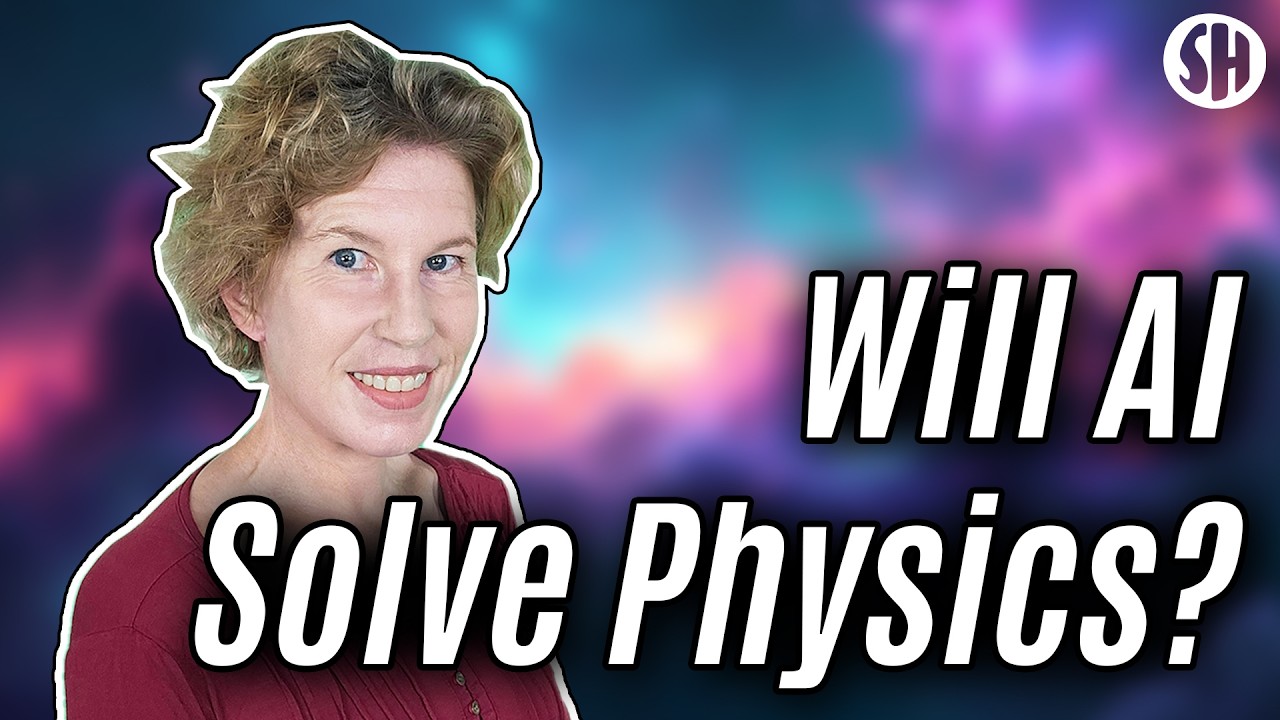
The video “Will AI Save Physics?” explores how artificial intelligence, particularly machine learning, can enhance physics research by efficiently analyzing complex data and aiding in hypothesis generation, while emphasizing that human creativity and theoretical insight remain essential. It concludes that AI will not single-handedly solve physics’ biggest challenges but will serve as a powerful collaborator, accelerating discoveries and deepening our understanding of the universe.
The video “Will AI Save Physics?” explores the potential impact of artificial intelligence on the field of physics, particularly in addressing some of its most challenging problems. It begins by highlighting the current state of physics, where many fundamental questions remain unanswered despite decades of research. The video suggests that traditional methods, relying heavily on human intuition and manual calculations, may be reaching their limits in solving complex physical phenomena.
Next, the video delves into how AI, especially machine learning and deep learning techniques, can assist physicists by analyzing vast amounts of data more efficiently than humans. AI algorithms can identify patterns and correlations that might be invisible to human researchers, enabling new insights into experimental results and theoretical models. This capability is particularly valuable in areas like quantum mechanics, cosmology, and particle physics, where data complexity and volume are immense.
The video also discusses specific examples where AI has already made significant contributions. For instance, AI has been used to optimize particle accelerator operations, simulate quantum systems, and even propose new physical theories. These successes demonstrate AI’s potential not just as a tool for data analysis but as a collaborator in the scientific discovery process, helping to generate hypotheses and guide experiments.
However, the video cautions that AI is not a panacea for all problems in physics. It emphasizes the importance of human creativity, intuition, and theoretical understanding, which AI currently cannot replicate. The integration of AI into physics research requires careful consideration of its limitations and the need for physicists to interpret and validate AI-generated results critically.
In conclusion, the video presents a balanced view, suggesting that while AI will not single-handedly “save” physics, it will undoubtedly become an indispensable partner in advancing the field. By augmenting human capabilities and opening new avenues for exploration, AI has the potential to accelerate discoveries and deepen our understanding of the universe, marking a new era in the pursuit of fundamental physics.