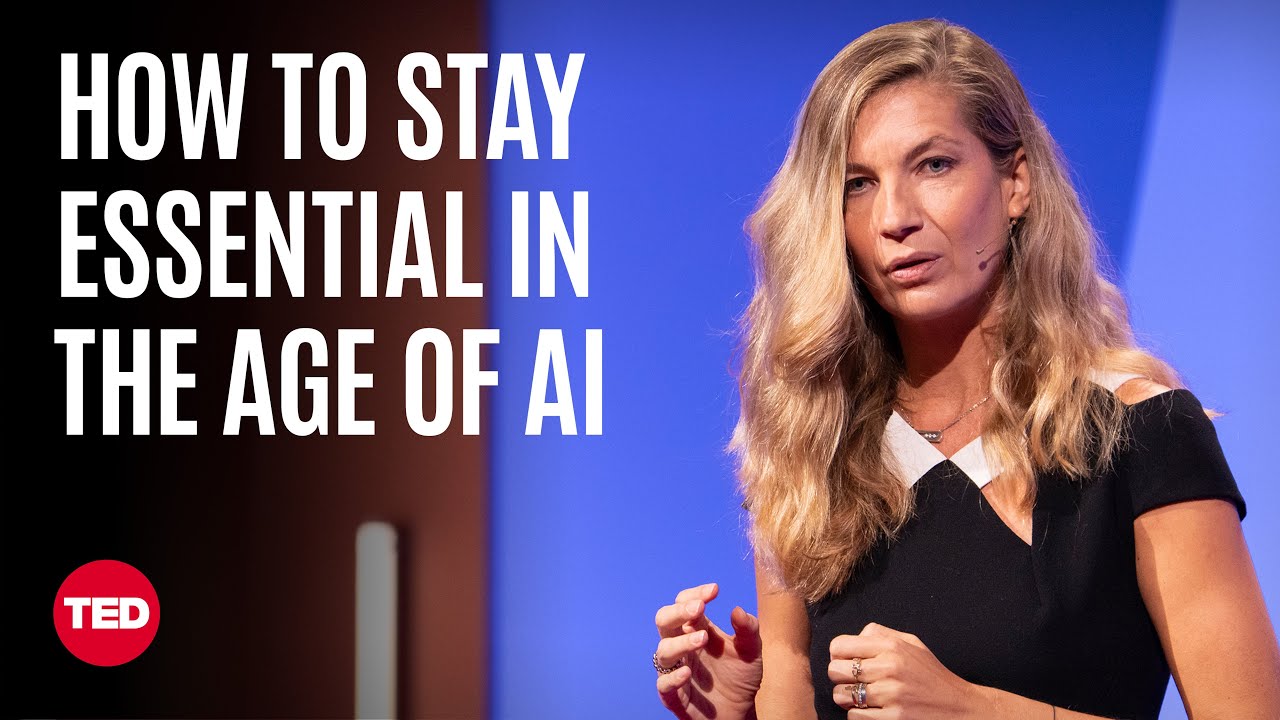
In her TED talk, Vinciane Beauchene challenges the conventional concern about AI taking over jobs, arguing that the real question is not whether AI will replace humans, but rather what unique value humans will continue to bring in an AI-driven world. She critiques the traditional Turing test, emphasizing that the ability to talk like a human is less important than the ability to do meaningful work. Beauchene’s focus is on helping organizations rethink their strategies by integrating AI in ways that enhance human talent rather than eliminate it, highlighting the importance of preserving human roles that foster relationships and emotional connections.
Beauchene illustrates this with a case study of a consumer goods company that initially aimed to automate its entire sales process using autonomous AI agents. However, upon deeper analysis, they discovered that customer loyalty was driven not by price or product alone, but by the emotional connection customers felt with human sales representatives. This insight led to a strategic shift where humans focused on building relationships and loyalty, while AI handled transactional tasks. This example underscores her point that human value is not disappearing but evolving in the age of AI.
She then addresses three common myths that hinder progress in adapting to AI. First, the belief that society will naturally adapt to AI as it has with past technological revolutions is flawed because AI advances exponentially while human adaptation is linear, making timely preparation critical. Second, the assumption that soft skills like empathy are uniquely human is challenged by evidence that AI can simulate empathy effectively, urging organizations to identify where humans truly add unique value. Third, the idea of protecting existing jobs is likened to anchoring a boat in a storm; instead, organizations should invest in human potential and adaptability, as rigid job structures will not survive rapid AI-driven changes.
Beauchene advocates for a radical, AI-first reinvention of business strategies rather than incremental adjustments. She describes an ideal approach where companies start with strategic outcomes, understand how AI agents can transform workflows, and identify where human contributions remain essential. This involves detailed workforce planning, skills forecasting, and upskilling initiatives to prepare employees for new roles that complement AI capabilities. She shares examples of companies successfully navigating this transformation by redefining roles and investing heavily in talent development and mobility.
Ultimately, Beauchene emphasizes that the future of work is not about humans versus AI but about human differentiation and collaboration with AI. She calls for organizations to commit publicly to developing their talent, protecting time for learning, and fostering values like trust, authenticity, and accountability. In this new era, being human is not a fallback but a deliberate practice that can create exceptional value. The challenge is not whether jobs will exist but what humans will excel at, making the human role in the AI age both vital and transformative.