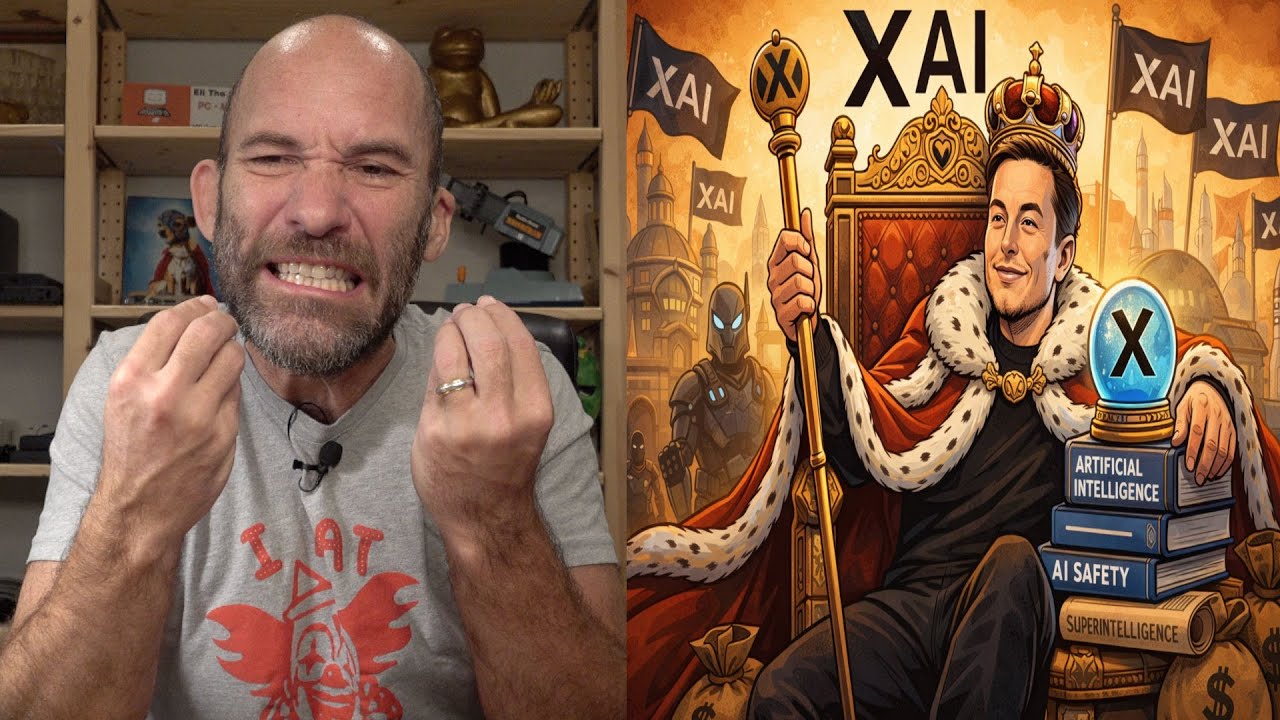
Certainly! Here’s a five-paragraph summary of the video:
The video, hosted by Eli the Computer Guy, discusses the ongoing competition in the artificial intelligence (AI) industry, focusing on Elon Musk’s company xAI and its prospects against OpenAI, led by Sam Altman. Eli opens by reflecting on how the tech industry often produces unexpected winners and losers, citing examples like Intel’s decline despite its dominance and Google+’s failure despite Google’s massive ecosystem. He uses these examples to illustrate that technological superiority or early market dominance doesn’t always guarantee long-term success.
Eli then delves into Elon Musk’s recent statements about xAI. Musk believes that if xAI can survive the next two to three years, it could potentially win the AI race. This is based on the idea that many current tech giants, especially in AI, are over-leveraged and may face financial difficulties due to unsustainable valuations and spending. Eli points out that Sam Altman’s OpenAI, for example, is pursuing massive capital expenditures and sky-high valuations, which may not be sustainable and could lead to significant “down rounds” or even bankruptcy if the financial bubble bursts.
A key point Eli raises is that much of the current innovation in AI is not technological but financial—centered around funding, licensing, and legal maneuvering. He suggests that companies focused on sustainable revenue and real user bases, rather than just chasing investment and inflated valuations, may ultimately come out ahead. In this context, xAI’s strategy of leveraging Musk’s other companies, like Tesla and SpaceX, to guarantee revenue streams could give it a significant advantage.
Eli also discusses the corporate structure of Musk’s companies, noting that while xAI, Tesla, and SpaceX are legally separate entities, Musk’s control allows him to direct business between them. For example, Tesla integrating xAI’s Grok AI into its vehicles creates a “captive market” for xAI, ensuring billions in annual revenue regardless of external demand. This internal synergy could help xAI weather financial storms that might sink more precariously funded competitors like OpenAI.
In conclusion, Eli emphasizes that the AI industry is still very immature, and it’s far too early to predict definitive winners and losers. He suggests that survival over the next few years, especially with stable revenue and strategic partnerships, could be more important than current hype or valuation. Eli invites viewers to consider whether xAI’s approach—focusing on sustainability and leveraging internal markets—might position it to outlast and outperform competitors like OpenAI, especially if the financial bubble in AI bursts. He closes by encouraging discussion and promoting his educational initiative, Silicon Dojo.