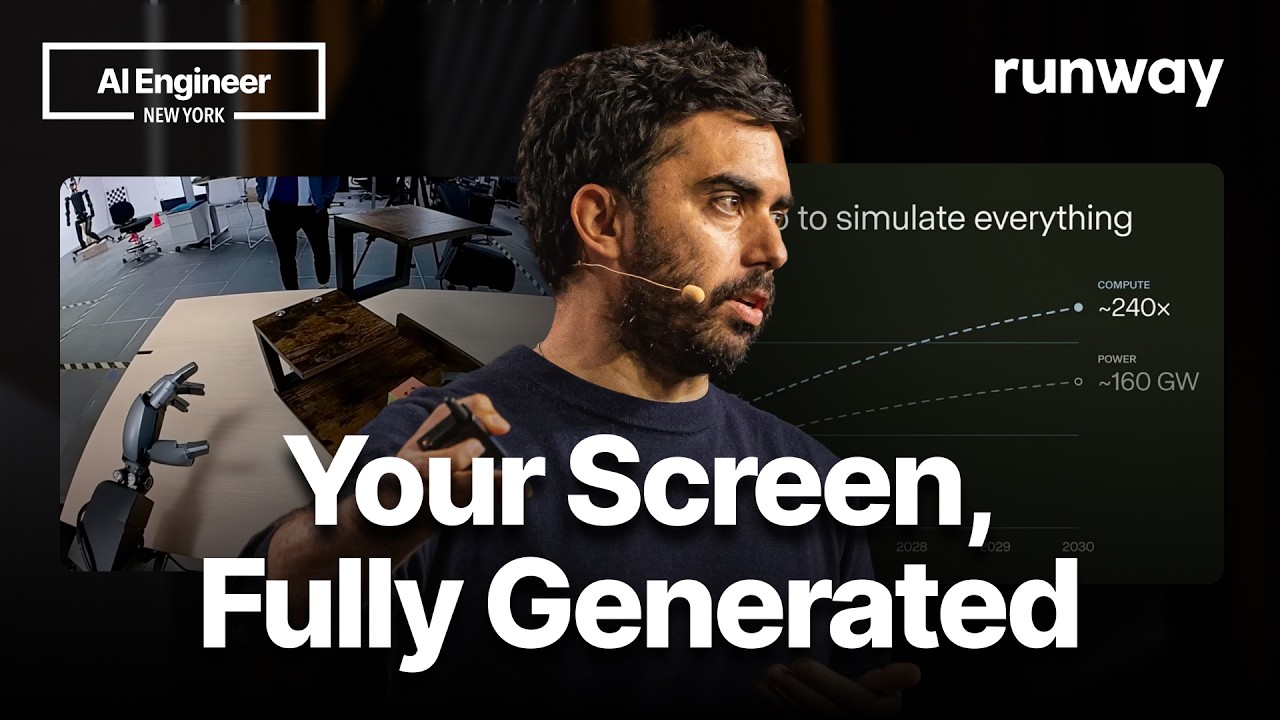
Cristóbal Valenzuela, co-founder of Runway, presents an insightful talk on the evolution and future of video generation and simulation technology. He begins by reflecting on the early days of AI-generated video, showcasing a 2019 project called “The Orange,” which, despite its low resolution and primitive quality, marked a significant milestone in AI-driven pixel generation. Valenzuela contrasts this with today’s state-of-the-art video models that produce hyper-realistic, entirely synthetic videos indistinguishable from real footage, emphasizing the rapid progress made in just a few years.
At the core of Runway’s work is the concept of next-frame prediction, a principle rooted in the origins of cinema as an optical illusion of movement. By scaling this idea with advanced neural networks and massive computational power, Runway’s models not only generate realistic video frames but also implicitly learn complex physical concepts such as gravity, object permanence, and occlusion. This enables the creation of consistent, believable video simulations that can mimic real-world physics without explicit programming, blurring the lines between video generation and simulation engines.
Valenzuela highlights the transition from passive video generation to interactive, real-time video models. These models allow users to manipulate and interact with video content dynamically, effectively turning any pixel on a screen into part of a responsive world. This capability extends beyond entertainment into robotics, where video models serve as the cognitive framework for autonomous systems navigating and reasoning about their environments. The interactive nature of these models opens up new possibilities for applications that merge video, simulation, and user interaction seamlessly.
One of the most groundbreaking concepts introduced is “Continuum,” a vision for an operating system powered by real-time video and world models. Continuum transforms traditional static content, such as websites and educational materials, into interactive, immersive portals that respond to user inputs and adapt in real time. This system supports “visual thinking,” where AI agents use visual simulations to solve problems collaboratively with humans, offering a novel paradigm for human-computer interaction that goes beyond text-based commands to include rich, visual exploration and manipulation.
In conclusion, Valenzuela envisions a future where everything we see on screens is simulated and interactive, fundamentally changing how we engage with digital content. While these technologies are still in their infancy, Runway is committed to making them widely accessible within the next year. The talk underscores the transformative potential of scaling video models and simulation systems, suggesting that soon, the distinction between reality and simulation will become increasingly blurred, ushering in a new era of digital experience and creativity.
Useful Links