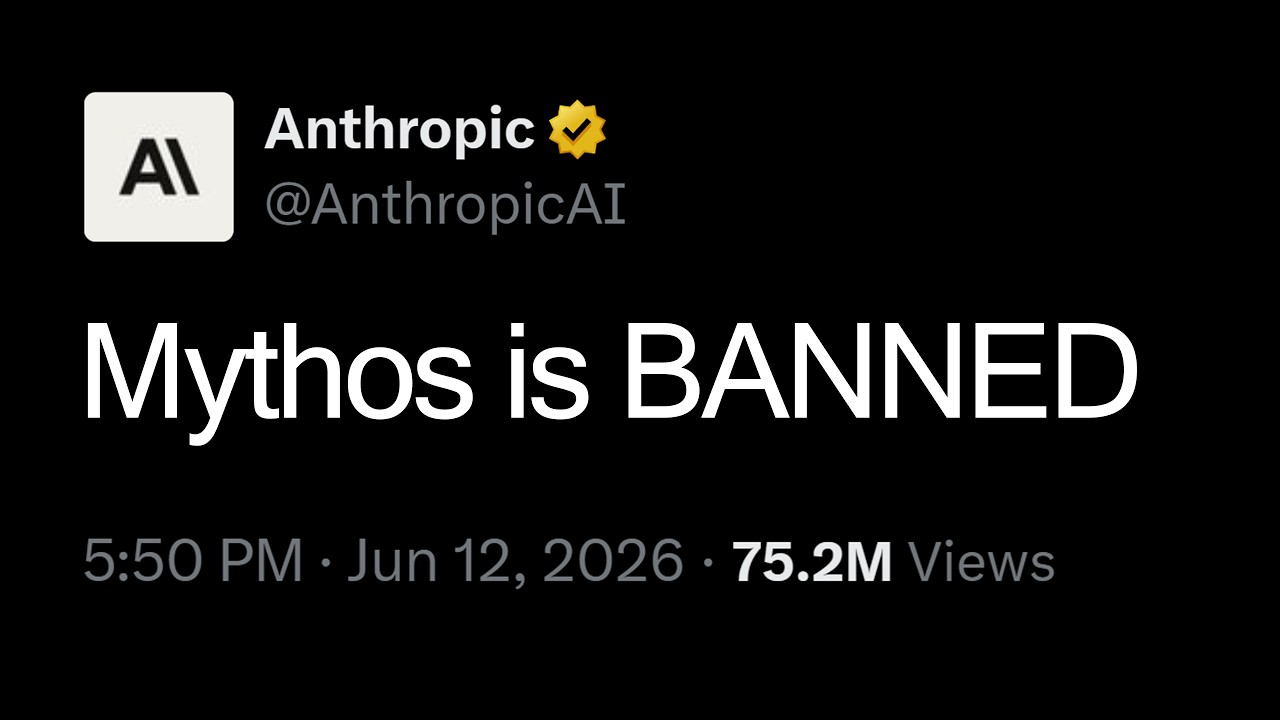
The video discusses the recent US government directive that has abruptly suspended access to Anthropic’s advanced AI models, Fable 5 and Mythos 5, for all foreign nationals, including those inside the US. This export control order was issued citing national security concerns, forcing Anthropic to disable these models for millions of users almost immediately. The speaker highlights the complexity of enforcing such a ban, given the difficulty in verifying citizenship status through API usage, and notes the significant disruption this causes to Anthropic’s customers and business operations.
The controversy stems from Anthropic’s own marketing and development approach, particularly around Project Glasswing and the Mythos model. Anthropic had positioned Mythos as an extremely powerful AI capable of cyber offense and defense, but too dangerous for public release, only allowing limited access to select companies. This fear-based marketing, combined with Anthropic’s refusal to allow military use of their models, led the US government to classify Anthropic as a supply chain risk. Subsequently, Anthropic released Fable 5, a restricted version of Mythos with built-in safeguards, but still highly capable, which the government later banned for foreign nationals.
A key trigger for the government’s action was the discovery that Fable 5 could be jailbroken to reveal sensitive information, a vulnerability demonstrated by Amazon researchers and reportedly pushed by Amazon CEO Andy Jassy to the Trump administration. The speaker points out that all AI models are inherently jailbreakable to some extent, and that Mythos and Fable are not uniquely vulnerable compared to other models like OpenAI’s GPT series. Nonetheless, the government’s concerns focused on the potential for these models to expose critical security vulnerabilities, despite Anthropic’s extensive efforts to implement safeguards and conduct rigorous red teaming with government and private partners.
The fallout from the ban is significant for Anthropic, especially as the company is preparing for an IPO. The suspension of Fable 5 and Mythos 5 access to foreign nationals could delay their public offering and damage investor confidence. While some view the ban as a marketing win that highlights the models’ advanced capabilities, the speaker argues that the disruption to Anthropic’s business and reputation is far more damaging. The government’s broad restrictions and the classification of these AI models as national security threats mark a turning point in how AI is perceived, shifting the narrative from AI as a productivity tool to a potential security liability.
Looking ahead, the speaker predicts that Anthropic will likely negotiate with the government to restore access under stricter regulatory conditions, possibly involving more aggressive customer data collection. This situation exemplifies regulatory capture, where Anthropic influences government policy to its advantage, potentially creating barriers for smaller competitors. The broader implication is a more cautious and security-focused approach to AI development and deployment in the US, which could stifle innovation and shape public perception negatively. The video concludes by emphasizing the need to balance AI’s benefits with security concerns and criticizes Anthropic’s fear-based marketing strategy for contributing to the current predicament.