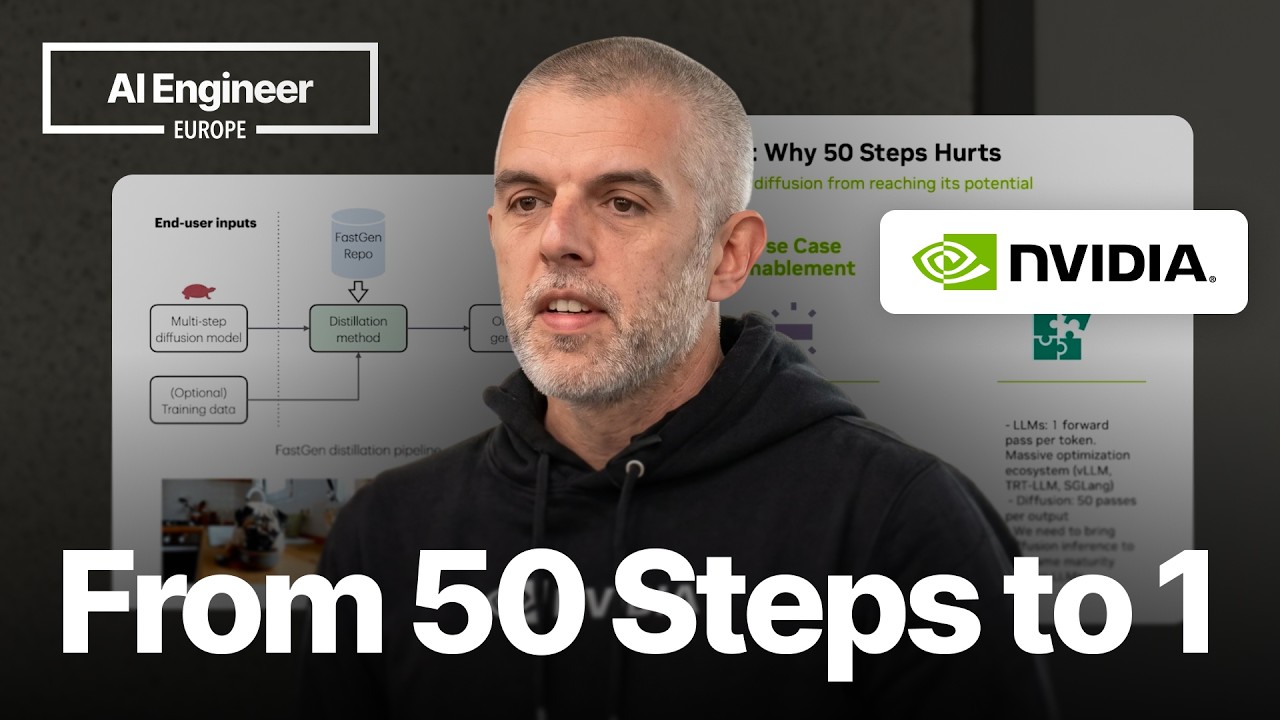
Ziv Ilan from Nvidia’s AI labs presented on optimizing diffusion models for image and video generation, emphasizing the need to make these models faster and more practical for real-world applications. Diffusion models typically require 20 to 50 denoising steps to generate high-quality outputs, but this latency poses challenges for developers and enterprises aiming for scalable, real-time solutions. Ziv highlighted that while diffusion models have gained significant traction recently, especially with models like Flux 2 and LTX 2, the ecosystem is still maturing compared to autoregressive models like LLMs and VLMs. To bridge this gap, Nvidia is exploring techniques inspired by LLM optimizations, focusing on quantization, caching, and distillation to reduce latency and computational demands.
Quantization is the simplest optimization discussed, involving reducing the precision of model parameters to save memory and improve performance. Ziv explained two main approaches: post-training quantization (PTQ) and quantization-aware training, with PTQ being easier but sometimes less effective for maintaining image quality. He noted that diffusion models are attention-heavy, making quantization less impactful than in LLMs but still a valuable low-hanging fruit. Nvidia has released tools and pre-quantized checkpoints to help developers adopt quantization easily, and ongoing research, such as attention FP4, continues to improve these methods.
Caching techniques aim to avoid redundant computations during the multiple denoising steps of diffusion models. Unlike autoregressive models where caching is straightforward, diffusion models require more nuanced approaches because they do not generate tokens sequentially. Ziv described methods like T-cache, which detects minimal changes between denoising steps to skip unnecessary recalculations, and more advanced chunk-based caching that isolates and recomputes only changing parts of an image or video frame. While caching can significantly boost performance, it must be carefully implemented to avoid degrading output quality.
Distillation was presented as the most impactful but complex optimization, focusing on reducing the number of diffusion steps needed to generate high-quality images or videos. Instead of shrinking the model size, distillation trains a student model to replicate the teacher model’s output with fewer steps, sometimes as few as one or four instead of fifty. This can yield 10x to 200x speed improvements, making real-time generation feasible. Ziv outlined two main distillation approaches: trajectory-based, where the student mimics the teacher’s denoising path, and distribution-based, where the student only matches the final output distribution. Nvidia’s FastGen framework supports these techniques, enabling scalable training and fine-tuning with open-source models.
In conclusion, Ziv emphasized that these optimization techniques—quantization, caching, and distillation—are incremental and can be combined to achieve better performance. He encouraged developers to start with simpler methods like quantization and progressively adopt more advanced strategies. The talk also addressed practical considerations such as compute requirements and dataset selection for fine-tuning, noting that distillation does not necessarily require the largest GPUs and that dataset specificity can impact quality. Nvidia continues to support the community with open-source tools and resources to advance diffusion model efficiency and real-time capabilities.