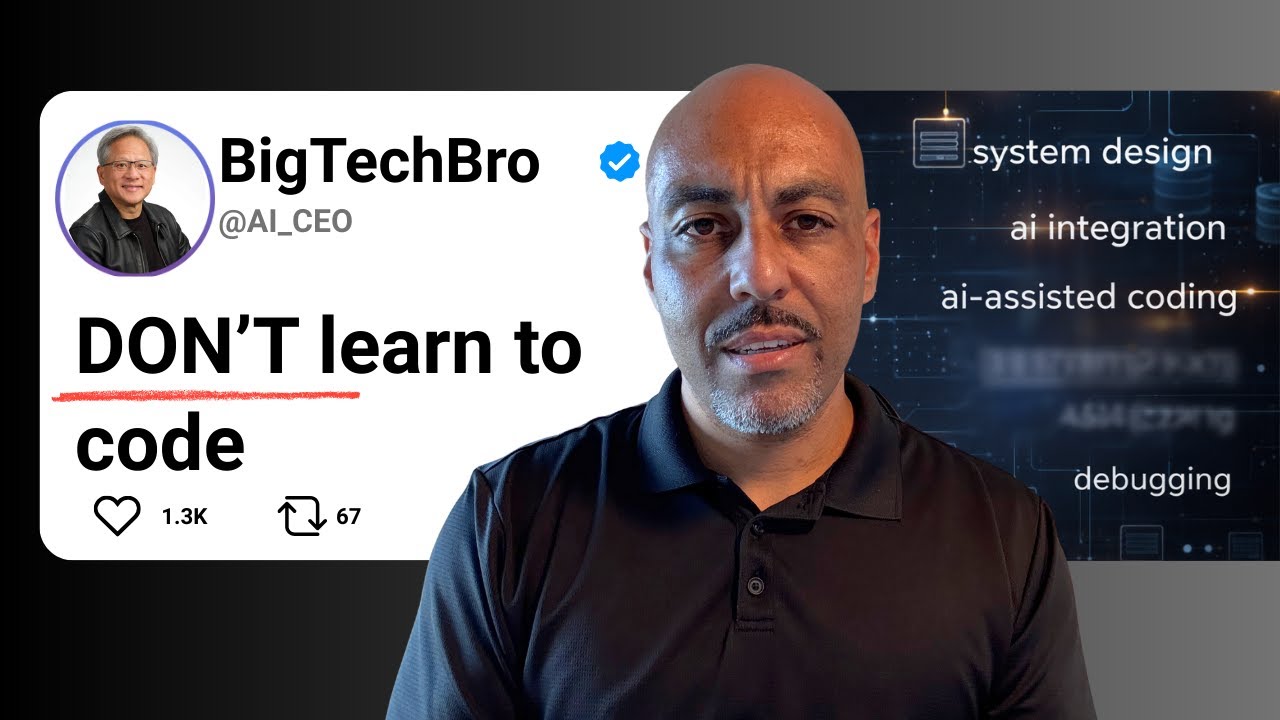
The video addresses the anxiety many aspiring programmers feel in the age of AI, where it seems like coding jobs are disappearing and AI can generate entire applications quickly. Despite the doom and gloom from influencers and tech news, the speaker argues that software careers are not dead. Instead, the landscape is shifting: while AI can write code, understanding how code works and how systems are designed is more important than ever. The ease of generating code with AI does not eliminate the need for human oversight, reasoning, and responsibility, especially as poorly understood or unchecked code can lead to security risks and costly mistakes.
The speaker emphasizes that learning to code remains essential, even if you rarely write code by hand. AI changes who writes the code, but not the need for code itself. Relying blindly on AI-generated code without understanding it can have catastrophic consequences, such as increased bugs, outages, and security breaches. The speaker warns that outsourcing your thinking to AI makes you vulnerable, especially if the AI is wrong or unavailable. Therefore, foundational knowledge in coding, system design, and how the internet works is crucial for anyone entering or staying in the tech field.
Self-teaching, especially with AI, is portrayed as more challenging than ever. While some succeed through self-study, they often have strong backgrounds, mentors, or ample time. For most people, using AI as a crutch can hinder real learning, making them overly dependent and ultimately unemployable if they cannot solve problems without AI assistance. The speaker suggests using AI as a learning tool for explanations and feedback, but not as a replacement for structured learning or mentorship. Generic AI-generated learning plans are often inadequate, lacking the context and feedback necessary for real progress.
To thrive in the evolving tech landscape, the speaker recommends focusing on durable, fundamental skills rather than chasing trends or shortcuts. As AI-generated code often contains more bugs than human-written code, debugging, system design, and understanding distributed systems become even more important. Developers should also learn the basics of how large language models work, including concepts like tokens, training, and hallucinations, as well as how to integrate AI into applications using APIs, embeddings, and agents. These skills are in high demand and can set you apart in a field where expertise is still scarce.
Finally, the speaker advises reading high-quality books to build depth and filter out online noise. While AI will likely write most code in the future, humans will still be needed to design systems, make decisions, and integrate tools. The most successful developers will be those who use AI to enhance their productivity without becoming dependent on it. The speaker encourages new programmers not to be discouraged by negative news, as the playing field is being reset and there are unique opportunities for those who focus on core skills and smartly leverage AI.