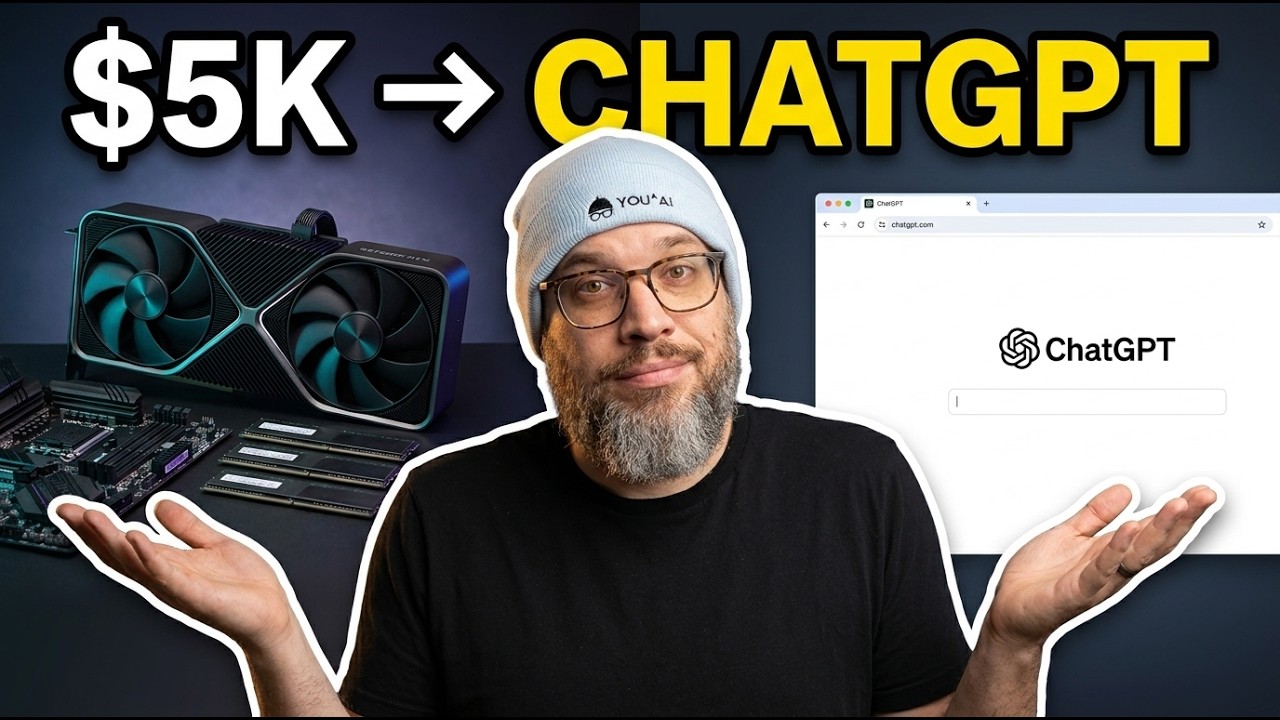
The video discusses the resurgence of the personal computer’s importance in the age of AI, emphasizing that AI agents increasingly need to interact deeply with local files, processes, and workflows. Unlike the past 15 years where computing shifted heavily to the cloud, useful AI now benefits from being close to the user’s personal data and context, such as notes, drafts, code, and meetings. This proximity allows AI to perform tasks more effectively, making the personal AI computer a critical component for privacy, ownership, and workflow integration. The video stresses that this is not about rejecting cloud AI but about balancing local control with cloud capabilities.
Building a personal AI computer involves more than just buying powerful hardware; it requires assembling a full stack that includes the machine, runtime software, models, memory systems, applications, and workflows. Hardware choices depend on the user’s specific needs, ranging from efficient Apple Silicon Macs for private writing and note-taking to high-end Nvidia GPU setups for coding and heavy inference workloads. The runtime layer, which manages model loading, inference, and API compatibility, is crucial for making local AI practical and user-friendly, with tools like llama.cpp and Ollama providing accessible interfaces.
Model selection should be based on the variety of tasks rather than a single “best” model. Users benefit from a portfolio of models tailored to different functions, such as fast local models for routine tasks, specialized coding models, embedding models for memory retrieval, speech transcription models like Whisper, and vision models for media processing. Open-source models like Llama 4, GPT-OSS, Qwen, and others are rapidly improving, enabling more workflows to be handled locally while reserving cloud models for the most complex or resource-intensive tasks.
Memory management is highlighted as the heart of a personal AI system, where the user’s data—notes, transcripts, code, and documents—should be stored and controlled locally. Tools like Open Brain provide open-source solutions for building durable, auditable, and private memory systems that integrate embeddings and databases for efficient retrieval. This approach contrasts with cloud-first models that own the user’s memory, emphasizing the importance of owning and managing one’s knowledge base to maintain privacy and long-term control over personal data.
Finally, the video outlines different user profiles and their ideal setups, from local-first knowledge workers seeking privacy and simplicity to maximalists requiring full local sovereignty, and developers focused on throughput and deployment. The personal AI computer is framed not as a nostalgic retreat but as a practical, evolving platform that integrates AI closely with personal workflows. It empowers users to decide which tasks stay local and which leverage the cloud, ensuring that AI serves as a tool under their control rather than a rented service dominating their digital lives.