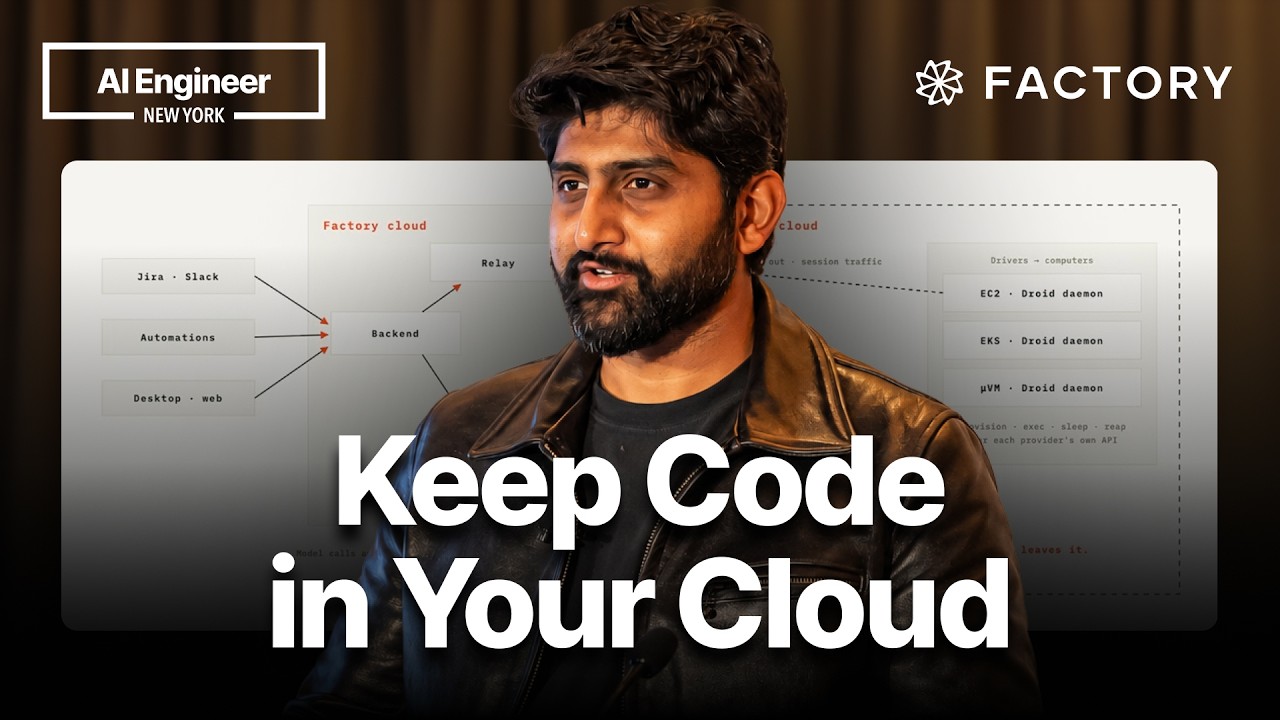
Nikhil Harithas, leading forward deployed engineering at Factory, discusses the challenges and solutions related to deploying AI agents in complex enterprise environments, using Blackstone—a large financial institution with stringent security and regulatory requirements—as a case study. He emphasizes that deployed engineering acts as the sensory nervous system of an engineering organization, helping to identify customer difficulties and inform product strategy. Blackstone’s environment posed unique challenges, such as strict control over compute resources, identity management, and single-tenant deployments, which made conventional agent deployment approaches ineffective.
Factory’s product, Droid, is an autonomous coding agent designed to integrate with tools like Slack and Jira to automate software engineering tasks. However, the core issues that repeatedly arose were “who is the agent acting on behalf of?” and “where does the agent run?” Many existing agent solutions rely on borrowing individual user identities and default compute environments, which Factory sees as a temporary and insufficient approach. Instead, they advocate for treating agents as applications that should leverage established software engineering principles, particularly around identity delegation and compute lifecycle management.
To address these challenges, Factory developed Open Compute, an open-source project designed to abstract and manage the compute lifecycle for agents across diverse environments. Open Compute enables agents to run on any compute infrastructure—whether Kubernetes, EC2, or other cloud or on-premises environments—while respecting customer security constraints and maintaining control within their own VPCs. This abstraction includes a compute gateway, drivers for different compute types, and a relay system that ensures secure, outbound-only connections, alleviating customer concerns about ingress traffic and enhancing trust.
Open Compute also supports advanced features like pausing, resuming, snapshotting, and forking compute sessions, which are critical for managing complex, multi-agent workflows and long-running tasks. The system is designed to be flexible and extensible, allowing customers to bring their own keys for LLM calls, manage secrets, and integrate with their preferred storage solutions. By decoupling compute management from specific product sessions, Open Compute offers a reusable, vendor-neutral framework that enterprises can adopt to maintain sovereignty over their AI infrastructure.
In conclusion, Harithas stresses that AI agents should be agnostic about where they run, and Factory’s approach with Open Compute provides a scalable, secure, and flexible solution to this problem. This approach not only meets the demanding requirements of large enterprises like Blackstone but also sets a foundation for future-proofing AI deployments by enabling customers to own their entire stack—from models to compute to control planes—on their own terms. Factory plans to open source Open Compute soon, inviting broader adoption and contribution to this evolving ecosystem.