Dr. Sid Pednekar’s talk, titled “Your AI Isn’t the Advantage. Your Judgment Is,” explores why, despite widespread AI adoption, only a small percentage of enterprises see significant positive impacts on their earnings before interest and taxes (EBIT). He emphasizes that while AI tools are abundant, the true scarce resource in this era is human judgment—the ability to choose what matters, make decisions amid uncertainty, and creatively explore possibilities. This judgment is critical across all organizational levels and functions, and the key question is where to best apply this finite capacity for maximum advantage.
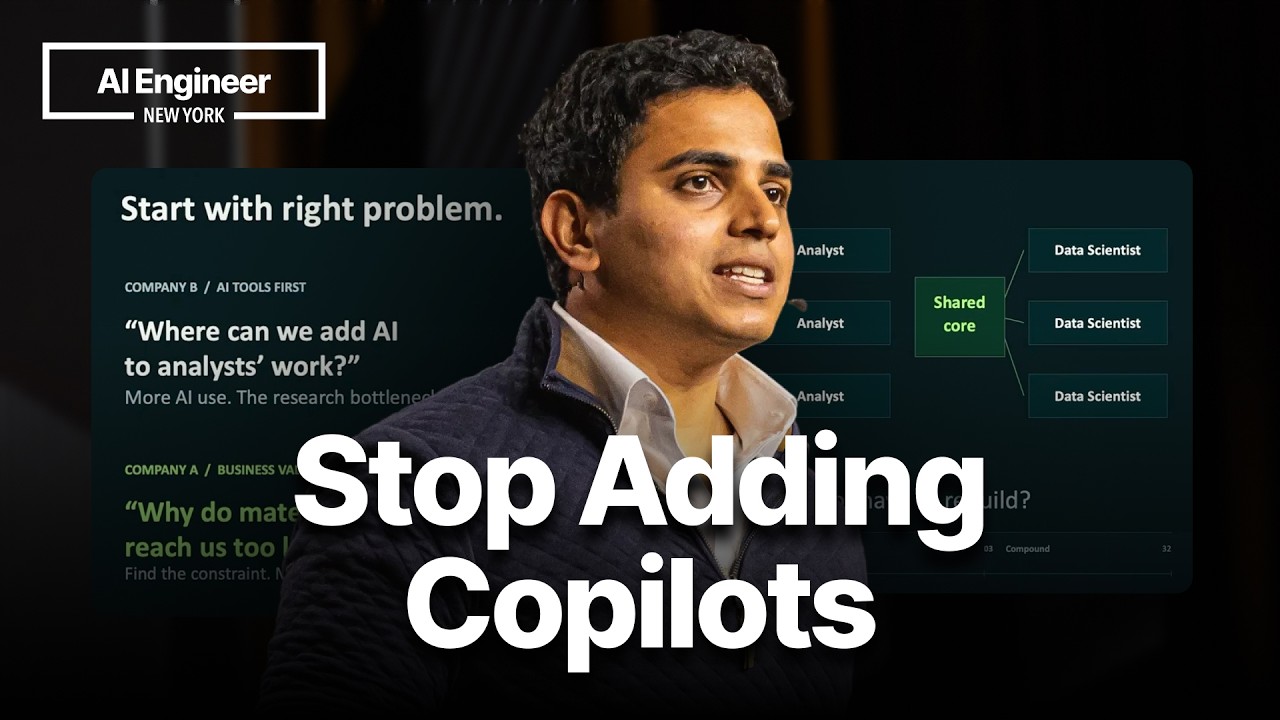
Pednekar introduces three pillars that leading organizations focus on to harness AI effectively: designing the right problem, building shared capabilities, and compounding the advantage. Using two hypothetical companies, A and B, he contrasts approaches. Company B starts with AI tools and tries to add them to existing workflows, such as speeding up document summarization, which risks losing important context. In contrast, Company A obsessively identifies the right problems to solve, redesigning workflows to focus AI efforts on bottlenecks and high-impact areas, leading to more meaningful improvements.
The second pillar, building shared capabilities, involves breaking down silos between technology and business teams and fostering collaboration. Leading firms integrate engineers, analysts, and business professionals to align AI efforts with business outcomes. They also standardize core infrastructure while personalizing solutions at the edges, enabling new team members to build on previous work rather than starting from scratch. This modernization of infrastructure is crucial, as traditional enterprise systems were not designed for AI agents that operate across workflows and applications.
The final pillar, compounding the advantage, focuses on learning from both successes and failures to continuously improve AI systems. Leading companies ensure that individual learnings are captured and integrated into organizational knowledge, preserving evidence and feedback loops that enhance future decision-making. This approach creates a flywheel effect where AI frees capacity, which is then reinvested into redesigning systems and focusing on key performance metrics, driving sustained competitive advantage.
In conclusion, Dr. Pednekar asserts that while AI is widely accessible, the true advantage lies in how organizations apply human judgment to identify the right problems, build collaborative and reusable capabilities, and continuously learn and improve. Company A exemplifies this approach by redesigning workflows around judgment and AI, whereas Company B merely adds AI tools to existing processes without strategic focus. The talk challenges organizations to rethink their AI strategies, emphasizing that judgment—not AI itself—is the critical differentiator in achieving lasting success.
Useful Links