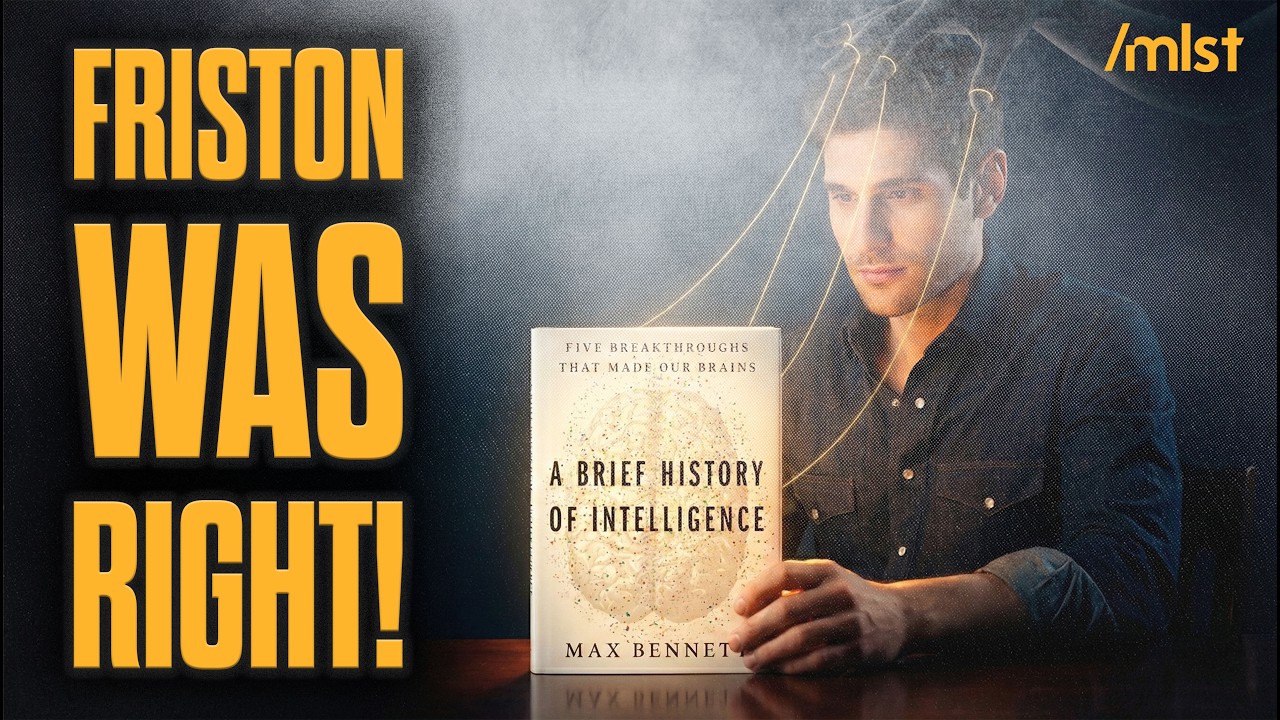
In this wide-ranging conversation, Max Bennett discusses the central thesis of his book: the brain is not simply a command center issuing orders to the body, but rather a sophisticated prediction machine that constructs models of the world and itself. Drawing from neuroscience, evolutionary biology, comparative psychology, and artificial intelligence, Bennett weaves together disparate theories from leading thinkers like Hinton, Hawkins, Damasio, and Friston. He emphasizes that, as an outsider to academia, his unique perspective allowed him to synthesize these ideas into a coherent narrative, focusing on how brains evolved through a series of breakthroughs—each enabling new forms of learning, planning, and social complexity.
A key theme is the brain’s reliance on generative models and predictive coding. Rather than passively receiving sensory input, the neocortex actively generates predictions about the world, constantly comparing them to incoming data and updating its models when discrepancies arise. This predictive process underlies not only perception but also imagination, planning, and even social cognition. Bennett explains classic visual illusions and phenomena like mental simulation as evidence that our conscious experience is shaped by these internal models, not direct sensory data. He also draws parallels between the brain’s generative modeling and the self-supervised learning seen in modern AI systems, though he notes important differences in agency and adaptability.
The conversation delves into the evolutionary trajectory of intelligence, highlighting how different animal lineages developed distinct cognitive capacities. Bennett describes how early vertebrates, mammals, and primates each acquired new brain structures—such as the basal ganglia and neocortex—that enabled more complex behaviors, from spatial navigation to episodic memory and model-based planning. He discusses experiments showing that even rats can mentally simulate future actions and learn from counterfactual outcomes, illustrating the deep evolutionary roots of imagination and planning. The emergence of the granular prefrontal cortex in primates, he argues, was crucial for metacognition, theory of mind, and the ability to model not just the world, but also oneself and others.
A major focus is on the social and cultural dimensions of intelligence. Bennett explores how primate brains expanded in response to increasingly complex social environments, leading to the development of theory of mind, deception, and intricate social hierarchies. He discusses the evolution of language as a uniquely human adaptation that enables the sharing of mental simulations, cumulative cultural knowledge, and the propagation of memes—ideas and behaviors that spread and evolve across generations. This collective intelligence, he argues, is not just a sum of individual brains but a dynamic, distributed process shaped by communication, teaching, and shared narratives.
Finally, the discussion turns to the implications for artificial intelligence and the future of human cognition. Bennett contrasts the strengths and limitations of current AI models, like large language models, with biological brains—highlighting differences in agency, continual learning, and the ability to generate and test hypotheses. He warns of the risks of offloading too much cognitive work to external systems, drawing analogies to the atrophy of physical skills in the age of automation. The conversation closes with reflections on the moral and philosophical questions raised by AI, the nature of sentience, and the ongoing co-evolution of brains, culture, and technology.