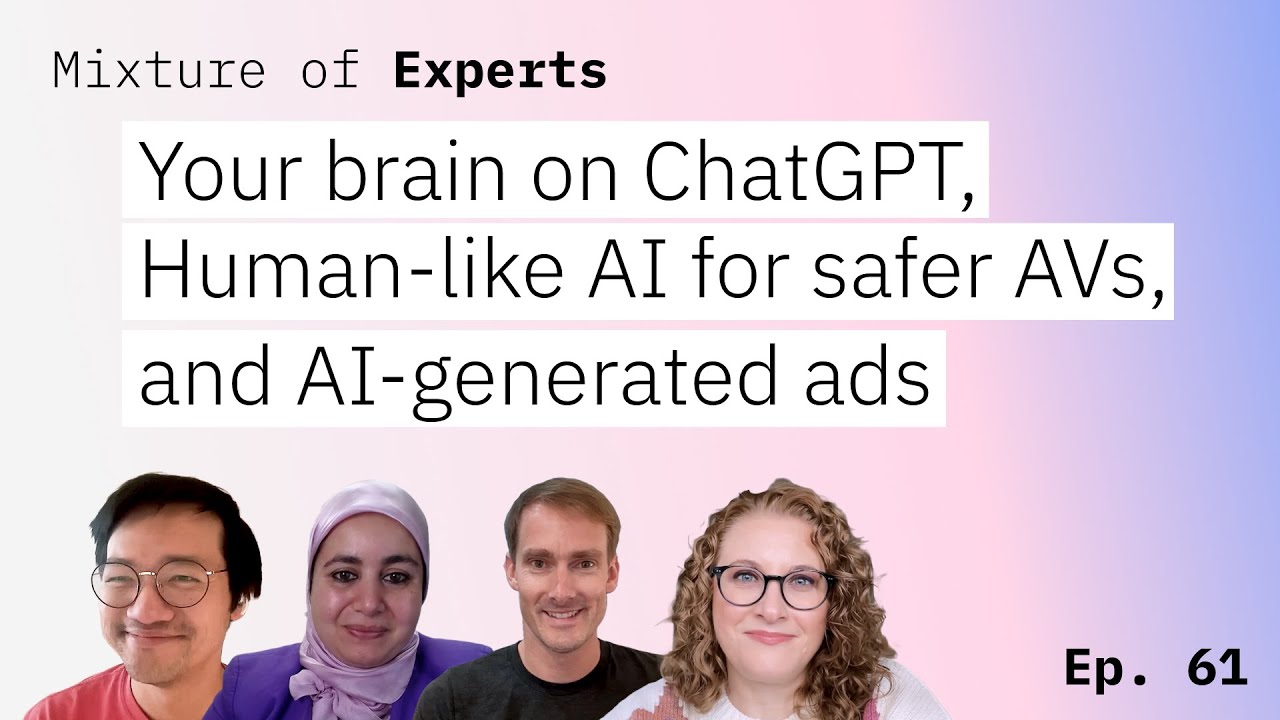
The episode of Mixture of Experts explores how AI impacts human cognition, autonomous vehicle behavior, and advertising, highlighting that AI’s benefits depend on thoughtful human engagement, adaptable technology, and ethical considerations. It emphasizes the need for balancing AI advancements with human creativity and oversight to navigate the challenges and opportunities of AI integration across industries.
The episode of Mixture of Experts begins with a discussion on a recent MIT paper titled “Your Brain on ChatGPT,” which explores how using large language models (LLMs) like ChatGPT affects brain activity. The researchers found that participants who relied on LLMs to write essays showed weaker neural connectivity and less brain engagement when later asked to write without AI assistance. The panelists reflect on whether AI tools make people smarter or dumber, concluding that the impact depends largely on how individuals engage with these tools. Using AI as an augmentation to enhance tasks one is skilled at can boost brain activity, while over-reliance on AI for tasks one struggles with may reduce cognitive engagement.
The conversation then shifts to autonomous vehicles (AVs), specifically focusing on Waymo’s evolving driving behavior. The panel discusses a San Francisco Chronicle article highlighting that Waymo’s robotaxis have started driving more assertively, mimicking human driving behaviors such as rolling starts at intersections. This shift from strict rule-following to more human-like, sometimes aggressive driving is argued to improve safety by better integrating AVs into the flow of human traffic. The panelists note the challenge of balancing algorithmic precision with social compatibility and suggest that AVs may need to adapt their driving styles to local cultural norms, much like chatbots adapt their responses based on context.
Building on this, the panel debates the complexity of training AVs in a world where multiple companies operate different autonomous fleets with varying driving styles. They highlight the need for dynamic, adaptable models that can learn and fine-tune behavior in real-time to handle diverse driving environments, from San Francisco to more aggressive driving cultures like Morocco. The idea of a technical “handshake” or communication protocol between different AV systems is proposed to help vehicles recognize and predict each other’s behavior, potentially reducing accidents and improving traffic flow.
The final major topic covers the emergence of generative AI in advertising, illustrated by a high-profile AI-generated ad aired during the NBA Finals by the prediction market company Kalshi. The panelists discuss how generative AI is now capable of producing high-quality, fast-paced ads that can be created at a fraction of the traditional cost and time. However, they raise concerns about ethical issues such as the unauthorized use of likenesses in AI-generated content and the potential for homogenized, hyper-targeted ads that may lack creativity or emotional impact. The discussion emphasizes that while AI can democratize content creation, human creativity remains essential for producing compelling and original advertising.
The episode concludes with reflections on the future of AI integration across industries and the importance of balancing technological advancement with human oversight and creativity. Ann Funai, a first-time guest, promotes her podcast “Transformers,” which explores AI-driven business transformations. The host also thanks the production team for their contributions to the show. Overall, the episode provides a nuanced exploration of AI’s impact on cognition, autonomous driving, and advertising, highlighting both the opportunities and challenges that lie ahead as AI technologies become increasingly embedded in everyday life.