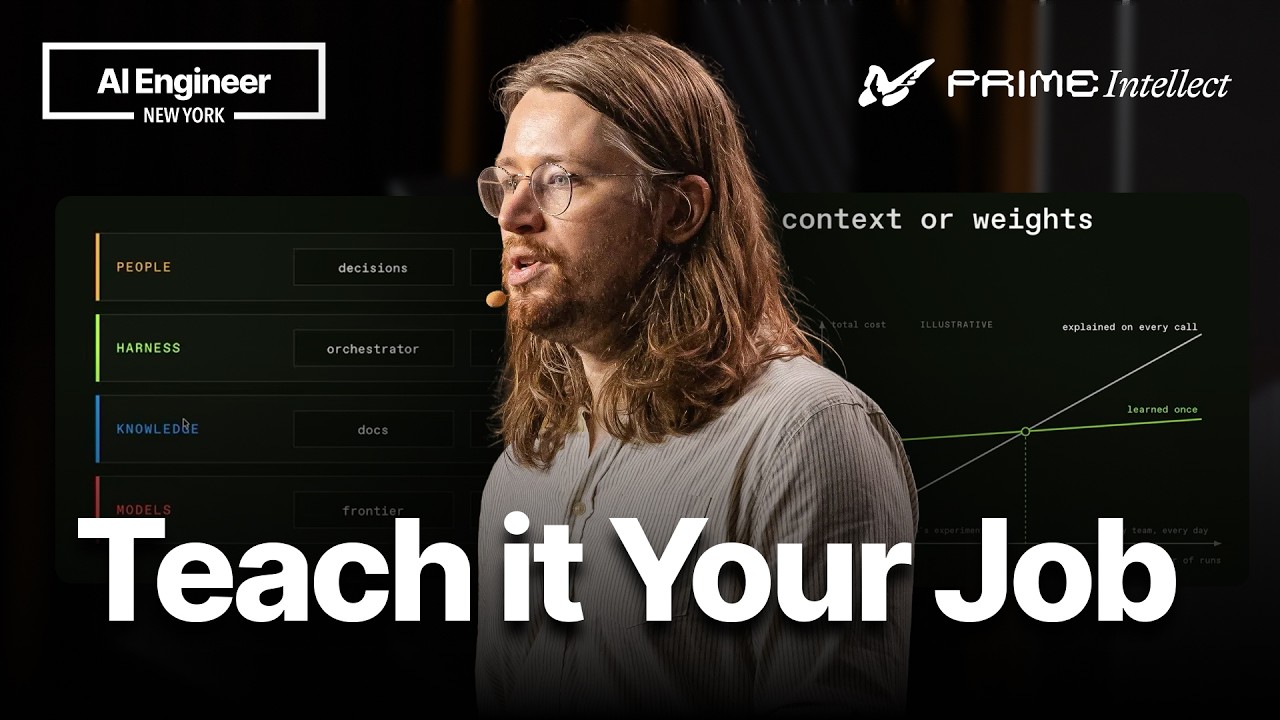
Will Brown, lead of applied research at Prime Intellect, opens his talk by reflecting on the rapid progress in AI, particularly in agents, interfaces, and bots, and emphasizes the importance of envisioning the future of AI at the organizational level. He highlights the shift from early chatbots and reasoners to sophisticated agents and innovators, posing the question of what it means for large enterprises to become truly AI-native. Brown stresses that future companies will deeply integrate AI agents throughout their workflows, leveraging their own data, people, and processes to build institutional knowledge and competitive advantage.
Brown explains Prime Intellect’s role in developing AI infrastructure focused on training, deploying, and continuously improving open-source models tailored to organizational needs. He underscores the value of training models on proprietary data to capture implicit organizational knowledge that often resides in employees’ heads, emails, meeting notes, and informal networks rather than formal documentation. AI agents, he argues, can identify inefficiencies and patterns across teams that humans alone might miss, enabling organizations to optimize workflows and decision-making processes.
A key challenge Brown identifies is that current AI agents learn in relatively primitive ways, primarily through in-context learning, which requires repeatedly processing large amounts of input data. He advocates for embedding more durable, institutional knowledge directly into model weights through training, allowing agents to become more effective co-workers who retain and build on organizational preferences, heuristics, and latent knowledge. This approach contrasts with the traditional, inefficient pipeline where expert knowledge is indirectly incorporated into frontier models through multiple intermediaries.
Brown proposes a practical path forward involving continual learning frameworks that treat models like codebases, complete with testing, evaluation, and iterative improvement. He highlights the emerging trend of decision models and cost-optimization strategies that can be integrated into organizational AI stacks to provide labeled feedback and human-in-the-loop supervision. By collecting usage traces and feedback, organizations can create rich training environments that blend real and synthetic data, enabling models to self-improve and better align with specific business contexts over time.
Concluding, Brown shares examples of organizations already investing in training custom models at scale and describes Prime Intellect’s vision for a future where companies run nightly training cycles to refine their AI agents using accumulated data and human feedback. This continual learning loop promises to unlock compounding benefits, making AI agents increasingly capable and aligned with organizational goals. He invites interested parties to engage with Prime Intellect’s open-source tools and collaborative efforts as they build toward this AI-native enterprise future.
Useful Links