The video discusses Youtu-Parsing-Omni, a single 5-billion parameter model from Tencent designed to handle five different input types—scan pages, flowcharts, charts, conversations, and videos—and return answers in a unified JSON format. This is significant because typically, different tools for OCR, charts, speech-to-text, and video captions produce outputs in varying formats, complicating integration. The model performs well on benchmarks like OmniDoc and OmniParsingBench, ranking just behind Gemini 3 Pro. The output JSON includes detailed elements such as IDs, categories, bounding boxes, and content, allowing reconstruction of documents or media in the correct order.
The presenter highlights the practical challenges of running the model, especially regarding hardware requirements. The model weights alone require about 10 GB of VRAM in BF16 precision, and the official setup demands a 65,000 token context, making it unsuitable for laptops with 8 GB VRAM like an RTX 4060. Instead, a GPU with at least 24 GB VRAM is recommended, with the Nvidia A40 (48 GB) being a preferred choice due to availability and cost-effectiveness on cloud platforms like RunPod. Setting up the environment proved difficult, requiring manual compilation of dependencies like flash attention and installation of missing packages, which took longer than the actual testing.
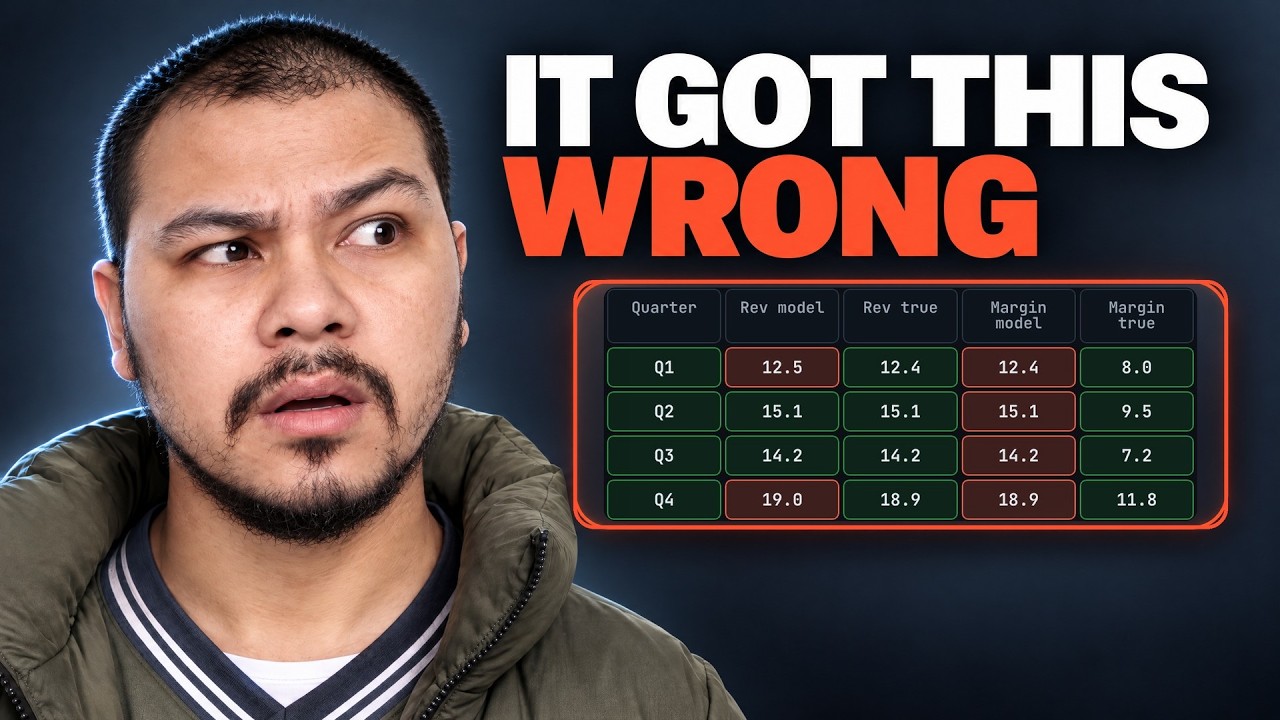
Five tests were conducted to evaluate the model’s performance on different input types. The first test on a noisy scanned technical page returned accurate elements including titles, paragraphs, tables, and formulas, with perfect table cell extraction and formula representation. The second test on an engineering flowchart successfully extracted all nodes and edges, including loops and labels. However, the third test on a financial chart revealed a critical flaw: while revenue bars were mostly correct, the model failed to accurately read the net margin line, instead copying revenue numbers, highlighting the difficulty of interpreting unlabeled chart lines.
The fourth test involved a recorded conversation with two synthetic voices, where the model correctly transcribed all six lines and distinguished speakers, though timestamps were imprecise and some segments were split incorrectly. The fifth test on a video with burnt-in subtitles and speech captions was successful, accurately capturing titles, subtitles, speech, and even describing icons, with segment boundaries within about a second. Overall, the model showed strong performance on scanned documents, flowcharts, and videos, but less reliability on charts and audio timestamps.
In conclusion, Youtu-Parsing-Omni demonstrates the potential of a single model to handle diverse input types and unify output formats, simplifying multi-modal data processing. However, users should be cautious with chart data accuracy and timestamp precision. The setup requires substantial GPU resources and technical effort, but cloud services like RunPod offer accessible options. The presenter invites viewers to suggest new inputs to test the model’s limits, emphasizing that while not a formal benchmark, the tests reveal practical strengths and weaknesses of this versatile AI tool.
Useful Links