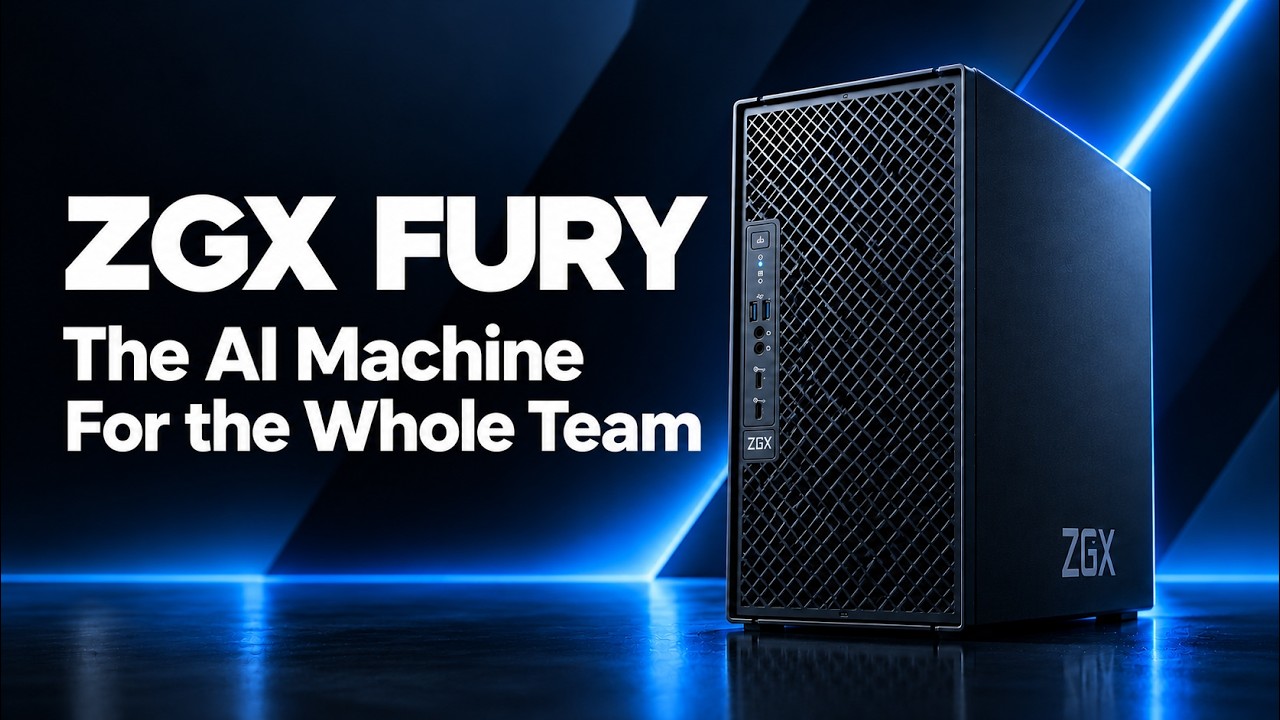
The video introduces the HP ZGX Fury DGX Station, a powerful AI workstation designed to serve an entire team rather than just an individual user. Unlike smaller models like the DGX Spark or ZGX Nano, which sit on a desk and handle single-user workloads, the ZGX Fury is a tower or rack-mountable machine capable of running large AI models concurrently for multiple users. It features Nvidia’s Blackwell GB3 chip paired with a 72-core Grace CPU, delivering 20 petaflops of AI compute at FP4 precision, along with an impressive 748 GB of shared RAM, including 252 GB of high-bandwidth memory (HBM) with 7.1 TB/s bandwidth, far surpassing typical professional workstation cards.
HP has customized the ZGX Fury beyond Nvidia’s reference design by adding unique software tools such as the HPZ Runtime (ZRT) toolkit. This command-line interface simplifies model deployment, optimization, and monitoring, allowing users to easily download models from Hugging Face, serve them, and track performance metrics like tokens per second and concurrency. Additionally, HP offers an extension for VS Code to streamline development workflows. The Fury also stands out by being the first GB300 station certified for Red Hat Enterprise Linux, aligning it with the operating systems commonly used in enterprise data centers.
A key partnership with Infinity AI has resulted in a specialized quantization of the Nemotron Super Model optimized for the Fury’s hardware, doubling the number of concurrent users and overall token throughput without sacrificing response speed. This highlights the machine’s ability to handle high concurrency workloads, supporting multiple users running inference, fine-tuning, and experimentation simultaneously. Tests demonstrated the Fury’s capacity to maintain high token generation rates even with dozens of concurrent users, all while remaining quiet and efficient.
The ZGX Fury is designed for team-based, on-premises AI workloads, making it ideal for enterprises that require data privacy, control, and scalability without incurring per-token API costs. Its architecture supports running multiple large language models (LLMs), embedding models, and multimodal models like image and video generation simultaneously, along with sandboxed environments for running various tools. This makes it particularly suitable for industries like healthcare, government, manufacturing, and cybersecurity, where data sovereignty and customization of AI models and guardrails are critical.
Overall, the HP ZGX Fury represents a shift from individual AI workstations to shared, enterprise-grade AI infrastructure that brings data center-level compute power directly to the office or on-premises server racks. Its combination of cutting-edge hardware, tailored software, and enterprise Linux support makes it a compelling solution for teams looking to build scalable, secure, and cost-effective local AI systems. While it may be beyond the budget of most individuals, it offers state-of-the-art performance and flexibility for organizations aiming to harness AI at scale without relying on cloud providers.
Useful Links