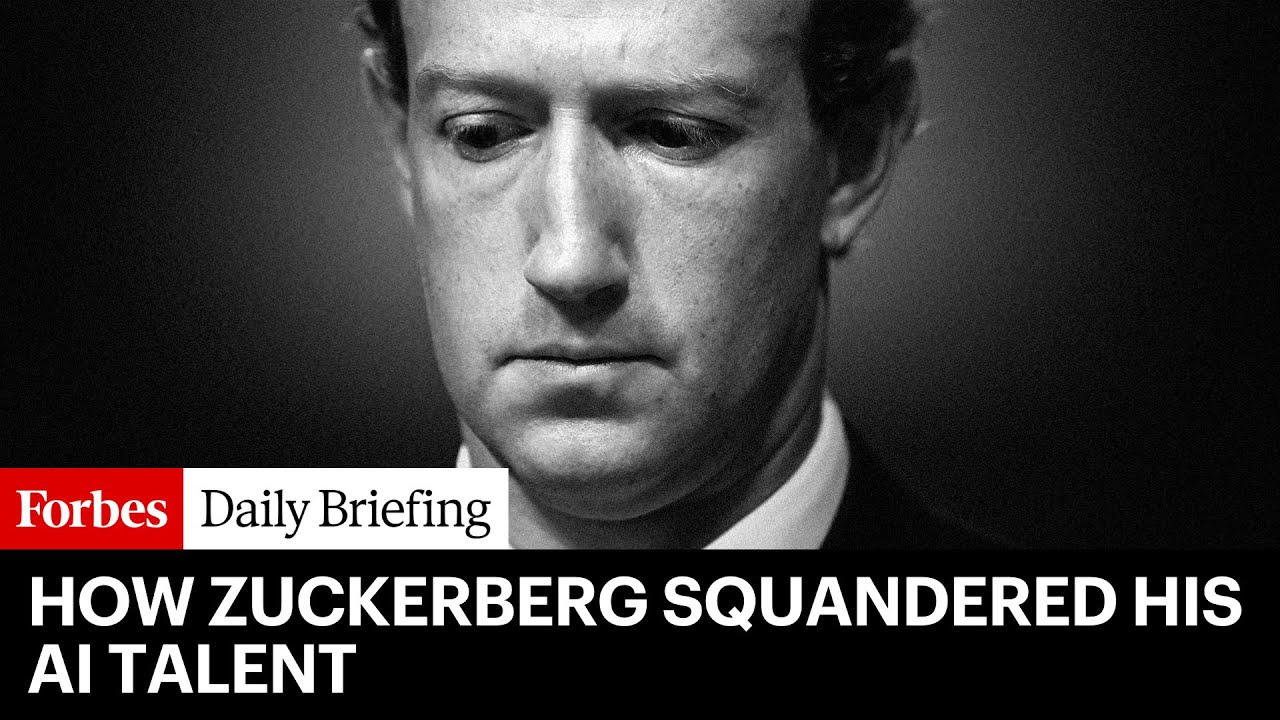
The video from Forbes discusses how Meta, formerly Facebook, once housed some of the top AI talent in the industry but has since experienced a significant brain drain. Many of its former AI researchers and engineers left to start or join major AI companies such as Perplexity, Mistral, Fireworks AI, and World Labs. Additionally, others moved to competitors like OpenAI, Anthropic, and Google, leaving Meta struggling to retain its leading position in AI research and development.
This loss of talent has been a major challenge for Meta, with insiders revealing that the company’s remaining AI researchers were often not considered top-tier by other leading AI firms. As a result, Meta has found itself in a difficult position when recruiting high-caliber AI experts, often being seen as an afterthought in Silicon Valley. The company’s reputation for AI talent had diminished to the point where Google, for example, hired very few AI employees from Meta compared to its overall hiring numbers.
In response to this talent drain, Mark Zuckerberg has embarked on an aggressive campaign to lure back top AI researchers by offering staggering compensation packages, including offers worth over $1 billion spread across multiple years. Despite these jaw-dropping offers, many sought-after AI professionals have declined Meta’s advances, preferring to work at companies where they believe they can have a bigger impact and better equity returns. This has led to perceptions of Meta as a company that overpays for “okayish” AI scientists, a comparison likened to an NFL team overpaying for average players.
Meta has strongly denied claims of talent issues and retention problems, with spokesperson Ryan Daniels dismissing the narrative as driven by unnamed sources with agendas. Meanwhile, competitors like Anthropic have maintained high retention rates, with Anthropic’s CEO noting that his company does not feel pressured to match Meta’s offers to keep employees. Data from VC firm SignalFire supports this, showing Meta’s retention rate for AI and engineering talent trailing behind other frontier AI labs like Anthropic, DeepMind, and OpenAI.
Despite these challenges, Meta continues to aggressively hire engineers and AI researchers, aiming to rebuild and expand its technical capabilities. The company is investing heavily to backfill experience lost to competitors and to scale new AI initiatives. This intense competition for senior AI talent reflects the broader industry pressure to innovate rapidly in AI, with Meta striving to regain its footing in the evolving landscape. For more detailed coverage, Forbes directs viewers to their full article by Rashi Shrivastava and Richard Neva.