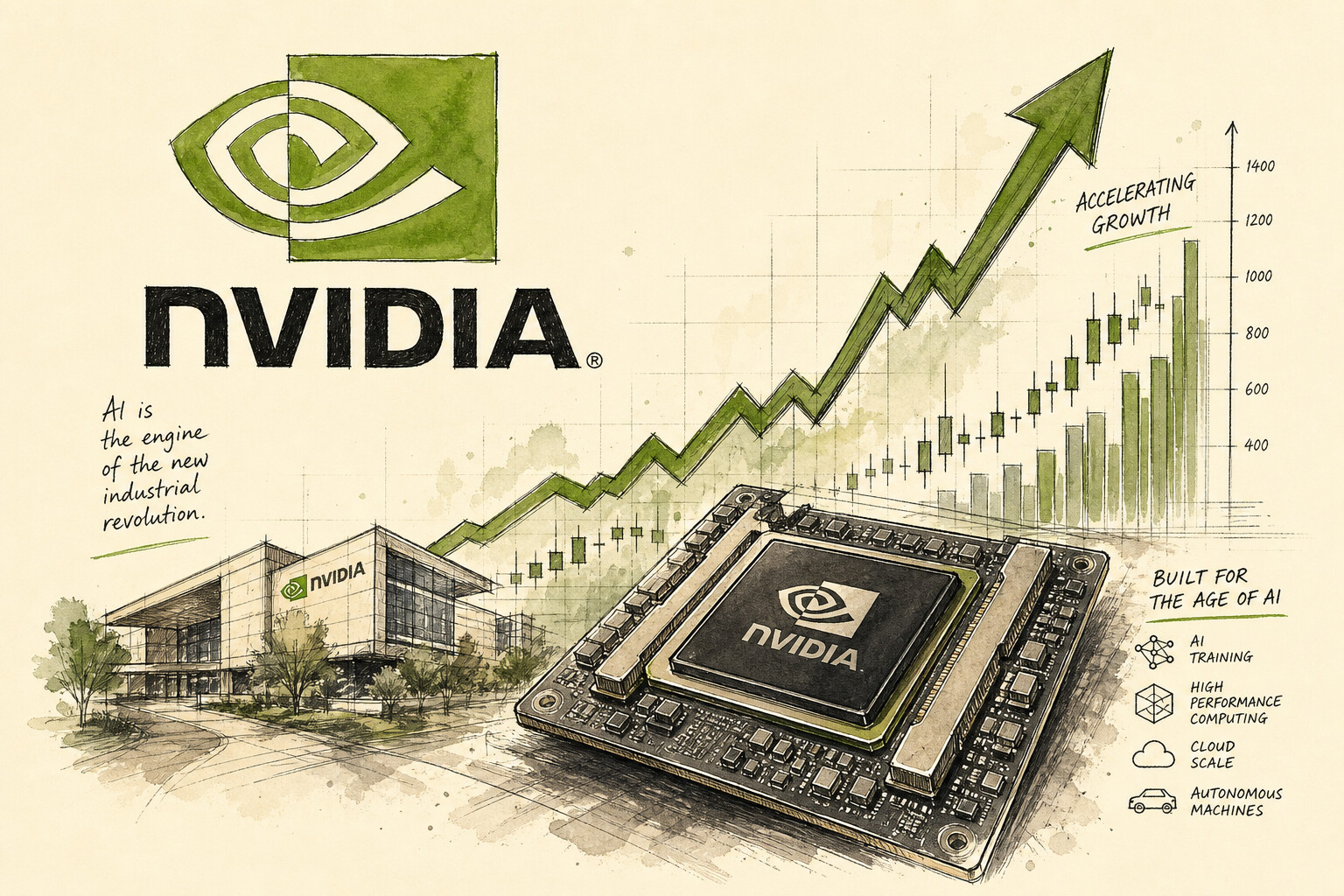
Nvidia has issued a rare and bullish long-term forecast, projecting approximately 70% revenue growth by its fiscal year 2028, fueled by persistent global demand for artificial intelligence (AI) infrastructure. The company’s outlook, which far exceeds Wall Street’s previous expectations of around 44% growth, has reassured investors and reinforced Nvidia’s position as a central player in the rapidly expanding AI hardware sector.
The forecast comes as Nvidia continues to experience robust demand from both major hyperscalers—large cloud providers such as Amazon Web Services (AWS)—and a rapidly growing segment of smaller, agile cloud companies known as “neo-clouds.” Nvidia and AWS have announced plans to deploy an additional 2 million GPUs across Amazon’s infrastructure in 2027 and 2028, underscoring the scale of anticipated AI workloads.
Nvidia’s CEO Jensen Huang described AI as having reached an “inflection point,” with AI tokens now considered productive and profitable, and compute power directly translating into revenue. The company’s Vera Rubin processors, which have begun shipping, are expected to account for about a fifth of Nvidia’s data center revenue in the current quarter.
Despite the optimistic outlook, Nvidia faces several challenges. Supply chain constraints, particularly in memory chips and semiconductor fabrication, are expected to limit how quickly the company can scale to meet demand. Soaring memory prices and higher component costs are also putting pressure on margins, which are forecast to bottom at around 71% to 72% in the fourth quarter, down from about 74% in the third quarter. To address these issues, Nvidia is planning price increases and has taken steps to strengthen its supply chain, including new financing efforts.
Nvidia is also working to diversify its customer base. While hyperscalers remain a significant source of revenue, the company is increasingly targeting smaller cloud providers and enterprises. This diversification is seen as a way to mitigate risks associated with customer concentration, especially as some large customers are developing their own in-house chips that could compete with Nvidia’s offerings.
The company’s presence in China remains uncertain due to ongoing U.S. export restrictions. Currently, less than 1% of Nvidia’s data center revenue comes from China, but recent regulatory changes could open new opportunities if access improves.
Nvidia’s embrace of open-source AI models and its reinvestment strategy—using free cash flow to support infrastructure and development—are expected to further broaden adoption and support continued growth. However, analysts caution that such ambitious forecasts should be viewed with some skepticism, as companies often present optimistic projections.
Overall, Nvidia’s detailed disclosures and strategic moves have helped ease concerns about a potential slowdown in AI investment, positioning the company for continued leadership in the AI hardware market through at least 2028.
Sources
Internal sources
- Nvidia Predicts AI-Fueled Surge Will Extend Into 2028
- Nvidia’s Upbeat Sales Outlook Eases Concerns About AI Economy
- Data Center Opposition Could Hurt Nvidia, Ferragu Says
- Nvidia Sees AI-Fueled Demand Boosting Sales 70% Next Year